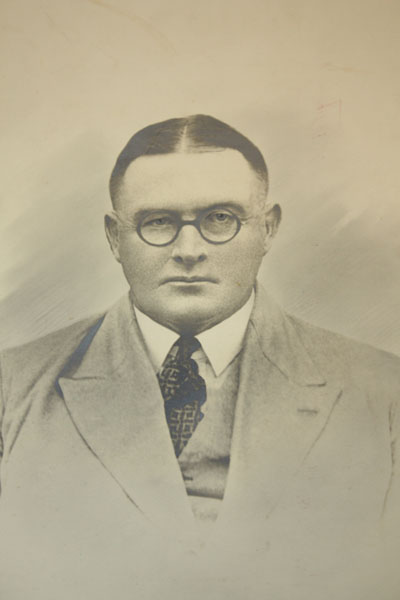
Walter Lancelot Travers was born in Birkenhead, Liverpool, in 1880. He was the fourth of eight children of Walter Benward Travers, a provision broker, and his wife, Helen (née Dawson). His connection to the Alford area came through his grandparents, as his grandfather served as the vicar of Mumby.
Travers’ early family life was unsettled. In 1890, his parents went through a highly acrimonious divorce that attracted national attention. However, even before this, in 1888, he had been adopted by his aunt, Edith Travers (his father’s unmarried sister) who lived in Alford. This move proved to be a positive turning point in his life.
In Alford, Travers found happiness and stability, developing a lifelong affection for the town. He attended Queen Elizabeth’s Grammar School, where he distinguished himself both academically and in sport. He captained the school’s football and cricket teams and also played for the town’s clubs. His loyalty to his school remained a defining feature throughout his life.
After leaving school, Travers worked for three years at the Spilsby and Alford branches of the Capital and Counties Bank. Despite this, he was determined to follow a family tradition of service in India. In 1900, he travelled to North Bengal to work as an assistant tea planter.
Travers quickly established a strong reputation, particularly for his fair and compassionate treatment of local workers. He learned their language and showed genuine concern for their welfare, earning widespread respect. Over a period of 32 years, he rose through the ranks to become a superintendent and later a manager.
His record of public service in India was notable. He joined the North Bengal Rifles and had reached the rank of Captain by the outbreak of the First World War. Although he was unable to serve on the front line due to the loss of sight in one eye, his valuable work behind the lines was recognised. He was mentioned in dispatches twice and was awarded an OBE in 1918.
During this period, India was undergoing significant political change, and Travers played an active role in public affairs. From 1914 to 1921, he served as Chairman of the Dooars Planters Association, advising the government on issues such as labour, education, and public health. In 1921, he was elected to the Bengal Legislative Council as a representative for North Bengal, becoming its leader in 1926.
Charitable work was also central to Travers’ life. He served as President of the Kalimpong Homes, an organisation that supported over 600 children by providing care and opportunities for a better future. In recognition of his contributions, he was knighted in 1931.
However, the demands of his professional, political, and charitable responsibilities took a toll on his health. In 1929, he was advised to take two years of rest. He stepped down from his political roles but continued his charitable work.
Throughout his years in India, Travers maintained close ties with Alford. In 1932, while speaking at the annual Alford Cricket Club dinner, he announced his intention to return to the town upon retirement. During this visit, he founded the Old Elizabethans Association, which enabled former pupils of Queen Elizabeth’s Grammar School to stay connected through annual gatherings and cricket matches.
Travers returned permanently to England in 1934. Soon after, he became engaged to his distant cousin, Carrie Mortlock. They were married at St Martin-in-the-Fields in London on 10 April 1935 and settled at Ulceby Manor, near Alford.
Back in England, Travers quickly became involved in local life. He maintained his connections with Alford Cricket Club and other organisations, and he served as a governor of Queen Elizabeth’s Grammar School.
His sudden death on 30 July 1937, following a short illness, came as a shock to the Alford community. He was buried at Rigsby Church, near the town he had loved so deeply.
Travers’ lasting affection for his former school was reflected in his will. After making provisions for his family and charitable causes, he left the remainder of his estate in trust. The income was to support former pupils in pursuing university education and to fund improvements to the school’s buildings and recreational facilities.
Sir W L Travers Educational Charity Application Form
Sir W L Travers Life